

How Agrivoltaics Is Quietly Solving Agriculture's Water Crisis
Water scarcity is reshaping how farms across Europe operate. Aquifers are running dry. Irrigation costs keep climbing. And every drought season raises the same uncomfortable question: how long can conventional farming sustain itself on shrinking water reserves?
Here's what's worth paying attention to. Solar panels placed above crops don't just generate electricity. They actively change the water dynamics of the land beneath them. The research backing this is growing fast, and the numbers are hard to dismiss.
Agriculture Has a Water Problem It Can't Outgrow
Agriculture accounts for roughly 70% of all global freshwater use. In drought-prone regions, that figure climbs even higher. The usual fixes follow a familiar pattern:
- Better irrigation infrastructure
- Drought-resistant crop varieties
- Fallowing land to reduce demand
None of these solve the root problem. They manage it. What agrivoltaics introduces is a fundamentally different approach – one where the structure generating clean energy also reduces how much water the land consumes.
The Research Is Clear on Water Savings
Studies show that agrivoltaic systems can cut irrigation requirements by up to 40% in regions with chronic water scarcity. That figure holds across multiple crop types and climates.
The reason comes down to microclimate. Solar panels reduce the intensity of radiation hitting the soil and crop canopy. This keeps temperatures lower and humidity higher. As a direct result, agrivoltaic systems reduce evapotranspiration by up to 31%.
Crop-level data makes the case even stronger:
- Irrigated lettuce used 20% less water under panel coverage
- Maize saw up to a 47% reduction in water demand depending on shading intensity
- Shade-tolerant crops like tomatoes needed up to 30% less water under partial shading
- Soil evaporation dropped by 14–33% under the panels
Less moisture leaving the soil means longer intervals between irrigation cycles. That directly cuts pumping costs and energy use.
A 2024 University of Sheffield study added another angle. Growing crops under solar panels produced greater yields with less water than open-field farming. The researchers also found that rainwater collected from the panels could supplement irrigation directly.
Design Makes the Difference
Not all agrivoltaic setups deliver the same results. Panel configuration shapes how much water the system saves.
Fixed-tilt east-west systems create different shade patterns compared to vertical bifacial or single-axis tracking designs. Some layouts shade the crop during peak midday heat while allowing light through in the morning and afternoon. That timing matters because evapotranspiration peaks at midday. Getting the shading right is what separates a high-performing system from one that just happens to have panels over a field.
Research from Spain tested regulated deficit irrigation alongside agrisolar shading for tomato crops in Madrid and Seville. The shade from the panels reduced evaporative demand. Crops developed adequately through most of the growing cycle. Farmers did not have to choose between saving water and protecting yield.
Water-use efficiency across agrivoltaic systems improves by 20–47%. Air and soil temperatures drop by 1–4°C. Crop resilience in water-scarce conditions increases measurably.
The Bigger Opportunity: Land That Works Twice
There's a land-use argument worth making clearly. Transitioning irrigated farmland to agrivoltaics reduces water consumption while generating renewable energy on land already in use.
The same parcel produces food, generates clean electricity, and conserves the water that enables both. In regions where groundwater management plans are already forcing reductions in irrigation, agrivoltaics offers farmers a viable economic path forward. It's not a trade-off. It's a dual-income model with lower input costs.
European agricultural policy is paying close attention. Land resilience in a changing climate now demands systems that do more with less, and agrivoltaic design sits at that intersection.
What Still Needs Work
The water-saving case is strong, but it isn't without caveats.
- Most studies are limited to specific crops, climates, or locations
- Long-term, large-scale field data is still limited
- System design must match local crop types, soil profiles, and weather patterns
A vineyard in southern France behaves differently from a cereal farm in the Czech Republic. What works in Seville will not automatically transfer to Scandinavia. Matching panel height, orientation, and spacing to specific farming conditions requires real engineering input and close collaboration between agronomists, developers, and farmers.
That knowledge-sharing gap is exactly what the sector needs to close.
Explore What's Next at the 5th Annual AgriVoltaics Europe
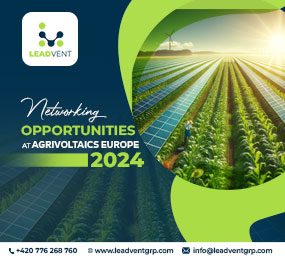
Water conservation is one of many topics on the agenda at the 5th Annual AgriVoltaics Europe, a leading agriculture solar event hosted by Leadvent Group on 17–19 November 2026 in Stuttgart, Germany.
Leadvent Group convenes decision-makers across clean energy's most critical transitions. This event brings together 35+ speakers and 250+ attendees across three days of expert sessions, case studies, and structured networking. The audience includes the following:
- Solar developers and EPC contractors
- Agricultural landowners and farm operators
- Project financiers and investors
- Policymakers and grid operators
- Technology providers and researchers
Sessions will cover crop-system compatibility, soil and irrigation considerations, energy vs. crop yield trade-offs, permitting across European markets, long-term monitoring, and biodiversity integration. Companies like RWE Renewables, NextEnergy Capital, JUWI, Belectric, and Recurrent Energy are among those represented.
Whether you develop, finance, farm, or build within this space, this renewable energy summit is where the field moves forward.
Register today for the 5th Annual AgriVoltaics Europe and be part of the conversations shaping the future of solar-integrated farming in Europe.
FAQs
- How much water can agrivoltaic systems realistically save?
Results vary by crop, climate, and system design. Most studies find 20–40% reductions in irrigation demand. Some crops in arid conditions reach savings closer to 47%. The main drivers are lower evapotranspiration, reduced soil temperatures, and higher humidity under the panel canopy.
- Does shading from solar panels harm crop yields?
Not for shade-tolerant crops. Lettuce, tomatoes, and certain berries often perform as well or better under partial shading, particularly during heat stress periods. The outcome depends on matching panel height, spacing, and orientation to the crop's light requirements. A well-designed system protects yield. A poorly designed one reduces it.
- Which crops benefit most from agrivoltaic water savings?
Leafy vegetables, tomatoes, and spinach show the strongest results. Viticulture in heat-stressed wine regions is an active area of study. Cereals and root crops show more variable outcomes and need careful system calibration before deployment.
- Is agrivoltaics viable outside sunny southern Europe?
Yes. Projects in the Netherlands, Germany, and Scandinavia show that agrivoltaic systems generate real value even in lower-irradiance environments. Water savings may be smaller in cooler climates, but the benefits around biodiversity, microclimate regulation, and dual income streams remain meaningful.




Comment