

Renewable Fuels: Accelerating the 2030 Transition
Fewer than four years remain until 2030. That is the deadline Europe's Renewable Energy Directive set for renewable fuel to play a meaningful role in transport. This year, the e-fuels sector has sent mixed signals. Developers committed more than $15 billion to new e-fuel production capacity in the Americas. Around the same time, one of Europe's e-methanol pioneers, Liquid Wind, filed for bankruptcy. Both events are real. Together, they show the tension facing an industry racing against a fixed deadline.
Where the 2030 targets actually stand
RED III sets several targets for 2030. Renewable fuels of non-biological origin, known as RFNBOs, need to reach specific shares across different sectors:
- Transport: a minimum 1% RFNBO share, folded into a combined 5.5% target alongside advanced biofuels
- Industrial hydrogen: 42% RFNBO by 2030, rising to 60% by 2035
- Aviation: e-kerosene blending quotas under ReFuelEU, starting low in 2030 and climbing through the following decade
Individual member states are moving faster than the EU floor. Germany's RED III transposition was finalised in January 2026. It raised the national e-kerosene quota to 2.5% by 2030, more than double the EU minimum. Finland has gone further. It legislated a 4% RFNBO quota with no multipliers attached. Brussels sets the baseline. The countries serious about e-fuels are setting their own, higher bars.
The money is starting to move
Developers are no longer waiting for policy certainty before writing cheques. Recent commitments include:
- HIF Global's Texas and Uruguay facilities, representing more than $11 billion in committed capital, backed by gigawatt-scale electrolyser orders
- Denmark's Kassø power-to-X plant, run by European Energy and Mitsui, has converted e-methanol into fuel for existing vehicles
- Nordic Electrofuel and Norsk e-Fuel in Norway are together targeting close to a quarter of Europe's e-kerosene supply by 2030. Both are backed by a €40 million EU Innovation Fund grant
Much of this capacity is already under construction, or close to breaking ground. These are not paper commitments.
And the setbacks are just as real
The same period produced a run of reversals:
- Liquid Wind's bankruptcy in May 2026 removed a Nordic e-methanol developer from the pipeline entirely
- Synkero, the KLM, SkyNRG and Schiphol Airport aviation e-fuel project, was paused before construction began
- Air Products cancelled a £2 billion UK green hydrogen import terminal
- BP stepped back from hydrogen projects in the UK and Oman
Both companies pointed to insufficient long-term revenue support. The economics explain why. Analysts still price e-kerosene at four to eight times the cost of fossil jet fuel. No dedicated aviation e-fuel facility is expected to reach commercial operation before the back half of this decade. Scaling a production process is one challenge. Scaling it while the cost gap stays this wide is another challenge entirely.
Closing the gap: what still needs to happen
Three things tend to separate the projects that reach final investment decision from the ones that stall:
- E-fuel infrastructure: the hydrogen pipelines, CO2 sourcing agreements, refuelling systems and grid connections that public conversation often skips over. Without it, a fully funded plant has nowhere to send its output.
- Regulatory certainty on the input side: RED III's rules require renewable electricity output to match hydrogen production hour-by-hour from 2030. Developers say this adds real complexity to project financing.
- Patient capital: HIF Global and Nordic Electrofuel show it can be raised. Liquid Wind shows it can run out.
Developers building the next wave of Electrofuels capacity need all three factors in place at once. Right now, the pipeline often assumes they arrive in sequence. That assumption is proving costly.
Where this conversation continues
These questions sit at the centre of the 3rd Annual World e-Fuels Event in Amsterdam. The summit takes place on 8-9 December 2026. Leadvent Group, the B2B conference producer behind the summit, built its two-day programme around the gap this article has described. That gap sits between policy ambition and commercial delivery. Sessions cover electrolyser technology, production scale, and hydrogen and CO2 utilisation. Other sessions dig into certification, lifecycle assessment, and the financing and infrastructure questions developers face before reaching final investment decision.
The audience reflects where the industry stands right now. This is not a broad public gathering. It is built for senior professionals already close to these decisions, including:
- Project developers and technology engineers
- Energy analysts and investment analysts
- Policy advisors and government representatives
- Business development leads from oil and gas companies, EPC contractors, research institutes and financial institutions
Confirmed speakers include Nordic Electrofuel's chief executive Gunnar Holen and Tractebel's Sven Goethals, commercial director for hydrogen and decarbonisation. Analysts from Rystad Energy and Agora Verkehrswende are also confirmed to speak.
Is your organisation's e-fuels strategy ready for a fixed 2030 deadline? The industry's decision-makers will be answering exactly that question in Amsterdam. Seats are limited to keep discussions focused. Early registration includes speaker presentations, the full participant list, and one-to-one meeting slots with the people shaping this market. Review the agenda to see the full two-day programme. Then reserve your delegate pass now and secure your place at the 3rd Annual World e-Fuels Summit before spaces fill.
Frequently asked questions
1. Are e-fuels the same as biofuels?
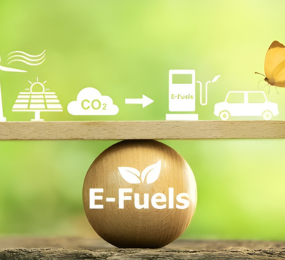
No. Biofuels come from biomass, such as crops, waste oils or organic material. E-fuels are also called synthetic fuels or power-to-X fuels. They are produced by combining green hydrogen from electrolysis with captured CO2. Both pathways count toward the EU's 2030 clean transport fuel targets. However, the feedstocks and production routes are entirely different.
2. Why do e-fuels currently cost more than fossil fuels?
Production needs large volumes of renewable electricity, industrial-scale electrolysis, and a source of captured carbon. All three remain expensive at today's plant scale. Analysts estimate e-kerosene costs four to eight times more than conventional jet fuel. Costs are expected to fall as electrolyser manufacturing and renewable power scale up together.
3. Which industries will adopt e-fuels first?
Aviation and shipping are the priority sectors. Both are difficult to electrify directly, and both face binding blending mandates under ReFuelEU Aviation and FuelEU Maritime. Road transport can shift to battery electric vehicles more easily. E-fuels are expected to play a smaller, longer-term role there.
4. When will e-fuels reach commercial-scale production?
A small number of facilities are already producing e-fuels at pilot and early-commercial scale, including Denmark's Kassø plant. Larger dedicated facilities from developers such as HIF Global and Nordic Electrofuel are targeting commercial operation later this decade. Timelines still depend on financing, offtake agreements, and electrolyser supply chains that are still maturing.








Comment