

Renewable Energy Summit 2026: Redefining Land Use and Food Security
European energy planners spent much of the past decade treating farmland and solar generation as competing claims on the same ground. The choice appeared binary. Land could grow food, or it could produce power, but rarely both. In 2026, that assumption no longer holds. Agrivoltaics, the practice of combining crop production with photovoltaic generation on one site, has moved from research trials into commercial deployment across Europe.
The shift matters to three groups at once. Investors see a new asset structure. Farmers gain a route to diversified income. Policymakers find a way to expand renewable capacity without displacing agricultural land. Together, these pressures have made agrivoltaics a defining theme at every serious renewable energy summit and solar power conference this year.
The land question that changed everything
Europe set demanding solar targets. Meeting them on rooftops alone is not realistic. That pushes developers towards open land, and open land is usually farmland. Rural communities have resisted, and often for good reason. Nobody wants energy security bought at the cost of food production.
reframes the Agrivoltaics whole argument. Instead of choosing between panels and produce, it stacks them. The scale of that opportunity is now well documented.
According to Fraunhofer ISE (2025), Germany alone could host up to 500 GW of agrivoltaics capacity on its most suitable agricultural land. That figure is more than double the country's installed solar target for 2030.
Researchers measure this dual-use gain with the Land Equivalent Ratio. When the ratio sits above 1.2, the combined system produces more per hectare than food or energy could deliver alone. Well-designed projects routinely clear that mark. The land does more work, not less.
What agrivoltaics actually changes on the ground
The technology is not panels dropped onto a field. Engineers tune the height, spacing, and angle of each panel to the crop below. Done well, the array becomes a working part of the farm.
Shade is the clearest example. Panels soften peak heat, slow evaporation, and shelter plants from hail and heavy rain. In hotter regions, that microclimate can protect yields rather than reduce them.
Research from the US National Renewable Energy Laboratory found that co-locating solar with agriculture can raise land-use efficiency by 60 to 200 per cent. In arid climates, it can also cut crop water demand by 20 to 50 per cent.
Crop choice is central. Leafy greens, berries, and forage crops tend to perform well under partial shade. Recent field trials have widened that list. Some vineyards, orchards, and grazing systems now hold up strongly under carefully spaced arrays. Southern France already grows wine grapes beneath dynamic panels.
The practical benefits fall into a few clear groups:
- Water resilience: lower evaporation and reduced irrigation demand
- Crop protection: shelter from heat stress, hail, and extreme weather
- Income diversity: a second revenue line from energy for the landowner
- Grid contribution: clean generation sited close to rural demand
How agrivoltaics is reshaping solar investment
For investors, the appeal is revenue stacking. One site now carries two income lines. The first comes from power sales or a land lease. The second comes from continued farming. That combination changes the risk profile of a project.
Diversified income makes a site more resilient to a poor harvest or a soft power price. It also strengthens community consent, which is often the real bottleneck in permitting. A farm that keeps farming is far easier to approve than a field taken out of production.
Capital is following that logic. Italy launched a programme worth roughly €1.7 billion to support agrivoltaics through its national recovery plan. Developers such as Statkraft are building agrivoltaics pipelines measured in gigawatts. Banks and funds now finance these projects as commercial ventures, not pilots. The financing conversation has matured. It now anchors any serious solar power conference.
Food security and the policy signal
The food security case is what lifts agrivoltaics from a clever idea to a strategic priority. Climate pressure, water scarcity, and volatile input costs are squeezing European agriculture. A system that generates income while keeping land productive speaks directly to that stress.
Policymakers have noticed. National and regional frameworks across the EU increasingly recognise dual-use land, and several now offer dedicated incentives. That regulatory clarity is what converts interest into built capacity. It also settles the food-versus-energy debate in favour of both.
For farmers, the promise is concrete. Stable energy income can offset a difficult season. Panel shade can carry a crop through a heatwave. The result is a stronger rural economy, not a hollowed-out one.
Where the agrivoltaics conversation goes next
Technology, finance, and policy are all moving quickly. They are not yet moving together. Farmers, developers, researchers, and regulators still need shared ground to align design standards, financing models, and permitting rules. That alignment happens in the room, at a focused agriculture solar event where each group can test its assumptions against the others.
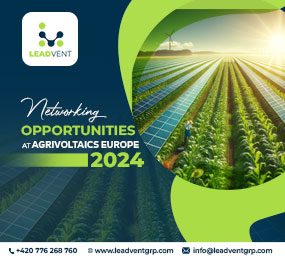
This is the purpose of the 5th Annual AgriVoltaics Europe, hosted by Leadvent Group in Stuttgart, Germany on 17–19 November 2026. The hybrid forum brings together more than 35 speakers and over 250 senior attendees from developers, investors, research institutes, and farming operations. Sessions cover system design, crop compatibility, energy-versus-yield trade-offs, permitting, and community-owned models.
Leadvent Group builds these forums around practical case studies and senior-level discussion rather than broad theory. Its agenda draws on active projects from organisations including RWE, Statkraft, Fraunhofer ISE, and Lightsource bp. For anyone weighing an agrivoltaics investment or a first dual-use project, the forum offers direct access to people who have already built and financed them.
Leadvent reserves delegate places for a senior-level audience, so seats are limited. Demand for the Stuttgart forum is strong. Early booking is advisable. Register now for the 5th Annual AgriVoltaics Europe to secure your place among the developers, investors, and researchers shaping the sector's next phase.
Frequently Asked Questions (FAQs)
1. What is agrivoltaics in simple terms?
Agrivoltaics is the practice of using the same land for farming and solar power at once. Developers raise panels above or beside crops, so the ground produces food while the array generates electricity. Careful design lets the two uses support each other rather than compete.
2. Does agrivoltaics reduce crop yields?
Not necessarily, and in some cases it improves them. Under the right design, panel shade lowers heat stress and water loss, which can protect or even lift yields for suitable crops. Poorly designed systems can reduce output, so crop selection and panel spacing are critical.
3. Is agrivoltaics a sound investment?
It can be, largely because it stacks two revenue streams on one site. Energy income and farm income together make a project more resilient to price swings and weak harvests. Stronger permitting outcomes and diversified returns are why investor interest has risen sharply.
4. Why attend an agrivoltaics conference in 2026?
The field is advancing fast across technology, finance, and regulation. A focused solar power conference lets developers, farmers, and investors compare real project data and align on standards. The 5th Annual AgriVoltaics Europe in Stuttgart is one such forum for that exchange.




Comment