

Building E-Fuel Infrastructure: Power to Distribution
Most articles on synthetic fuels focus on the destination. They talk about zero-emission flights or carbon-neutral shipping lanes. They rarely explain what stands between a wind turbine and a fuel tank. That gap determines which projects succeed and which stall at the announcement stage.
E-fuel production isn't a single step. It's a chain of interdependent systems, and each link carries its own cost, risk, and engineering challenge. Skip one link, and even a strong project loses momentum fast. Here's what that chain actually demands.
It Starts with Power, Not Fuel
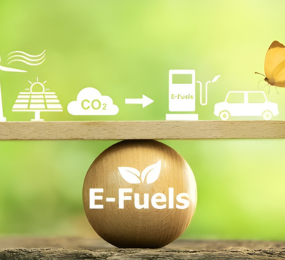
E-fuels begin as electricity. Producers source it from wind or solar, then split water into hydrogen and oxygen through electrolysis. The concept sounds simple. The execution rarely is.
Electrolysers need steady, high-volume power to run efficiently, but renewables don't deliver power on a fixed schedule. Developers face a tough choice:
- Oversize renewable capacity to compensate for intermittency
- Add battery storage to smooth out supply gaps
- Accept lower plant utilization and weaker economics
Grid connection adds further complexity. Many strong project sites sit far from existing transmission lines, so teams must build new infrastructure before producing any hydrogen. Permitting alone can add years to a timeline, often outlasting the construction phase itself.
Carbon Has to Come From Somewhere
Hydrogen alone won't work as a drop-in fuel for most applications. Producers combine it with carbon, typically through Fischer-Tropsch synthesis or methanol production, to create liquid fuels compatible with existing engines and aircraft.
That carbon must come from capture, not emissions:
- Direct air capture, which remains expensive and energy-intensive
- Point-source capture from industrial facilities, which costs less but depends on location and a shrinking supply, since the broader goal is decarbonizing those facilities too
Both pathways are improving, but neither is cheap or fast yet.
Whichever path a project picks, the carbon supply chain becomes its own logistics challenge, separate from the power chain in contracts, risks, and timelines. Misjudging this step can stall a plant that otherwise runs perfectly.
Production Plants Are Not Small
Synthesis facilities that turn hydrogen and carbon into liquid fuel demand heavy capital and complex engineering. Few exist anywhere at commercial scale. Most current facilities operate at pilot scale, so every new project absorbs hard lessons that previous projects didn't have access to.
Process engineers and EPC contractors are still working out standardised designs, and cost overruns happen often. Financing stays difficult too, since lenders want operational history the industry barely has yet. That gap between ambition and proven track record keeps slowing project approvals down.
Storage and Distribution: The Quiet Bottleneck
Clean fuel that nobody can move or store has no real value. This is where infrastructure gaps become most visible and where many projects underestimate the work ahead. A facility can produce perfect fuel and still fail commercially if it can't get that fuel to a buyer.
Hydrogen storage requires extreme compression or cryogenic cooling, both costly and technically demanding. Liquid e-fuels like e-methanol or e-kerosene have an advantage, since producers can often adapt existing terminals, pipelines, and tankers to handle them. That compatibility helps, but adaptation still means the following:
- Equipment inspection
- New certification processes
- Physical modification, since most infrastructure wasn't built with synthetic fuel in mind
E-fuel infrastructure also depends on end use. Aviation needs fuel at airports, shipping needs bunkering at ports, and road transport needs refuelling stations. Building networks that reach all three at once isn't realistic for most regions right now, so prioritisation becomes a strategic decision, not just a technical one.
Regulation Shapes Everything Upstream
Infrastructure decisions don't happen in isolation. Certification standards decide what counts as a genuine e-fuel for emissions accounting, and lifecycle assessment rules determine subsidy eligibility. Policies differ across the EU, the US, and Asia, complicating planning for companies working internationally. A plant built to one regulatory standard may not qualify under another, and that mismatch has already delayed several announced projects. Developers now factor regulatory alignment into site selection just as heavily as power access.
The Bigger Picture: Why an Integrated Supply Chain Wins
None of these pieces work alone. A brilliant electrolyzer means little without reliable renewable power behind it. A well-designed synthesis plant stalls without a steady carbon source. Fuel sitting in storage does nothing without distribution built to move it.
Treating e-fuel infrastructure as one connected chain, rather than separate projects, is what separates plans that scale from plans stuck at pilot stage. Developers who map the full chain early tend to avoid the costly surprises that derail others mid-build.
Where Industry Leaders Are Solving This
Leadvent Group's 3rd Annual World E-Fuels Summit brings this conversation to one room. The summit takes place in Amsterdam, Netherlands, on 8th to 9th December 2026.
Expect to find:
- Energy analysts and project developers working on production and scale-up
- Sustainability managers building decarbonization roadmaps
- Business development leads exploring offtake agreements
- Investment analysts and policy advisors assessing bankability and regulation
Sessions cover electrolyzer scale-up, carbon capture and reuse, certification frameworks, and the practical realities of distribution across aviation, marine, and road transport. Attendees leave with a clearer view of where the industry is headed next, not just where it stands today.
Seats are limited by design, and the value lies in direct access to the people building this infrastructure right now, not in a crowded hall of passive listeners. If your work touches renewable power, fuel production, or clean transport strategy, this is where the next deal, partnership, or insight is likely to start. Don't wait until the agenda fills up and the best networking slots are gone. Register for the 3rd Annual World E-Fuels Summit today and secure your place at this e-fuels event before seats fill up.
FAQs
- What makes e-fuel infrastructure different from regular fuel infrastructure?
E-fuel infrastructure requires dedicated electrolysis, carbon capture, and synthesis facilities upstream of storage and distribution. Conventional fossil fuel supply chains don't need any of these steps.
- Can existing fuel terminals handle e-fuels?
Liquid e-fuels like e-methanol and e-kerosene can often use adapted versions of existing terminals and pipelines, though certification and modification are usually required first.
- Why is renewable power availability such a major constraint?
Electrolyzers need consistent, high-volume power to run efficiently. Wind and solar generation is intermittent, so developers must invest in oversized capacity or storage solutions.
- Who should attend the World E-Fuels Summit?
Energy analysts, project developers, policy advisors, technology engineers, and investors working on production, infrastructure, or financing decisions across the e-fuels value chain will benefit most.



Comment